The IEI Standard Model
A web-native, version-controlled blueprint of the Standard Model. This living document operates as an expandable state-space map—translating complex non-equilibrium thermodynamics into a modular visual runway of attractor landscapes, basin dynamics, and phenotypic structural thresholds.
Systemic Abstract // Executive Summary
- Document Classification:Institutional Position Paper / Open-Access Monograph
- Core Focus:Non-Equilibrium Thermodynamic Stability & Sub-Cortical Predictive Control
- Validation Horizon:7-Year N=1 Empirical Dataset to Multi-Scale Institutional Frameworks
- Release Version:v2.1.2 (Public Framework Architecture)
1. The Biophysical Operating Deficit
This monograph outlines the mathematical physics and physiological protocols required to transition human biological assets from the high-entropy, high-curvature configurations of the Abandoned State into the self-sustaining, low-curvature attractor basins of the Prime State. Current macro-scale institutions, public health frameworks, and capital networks are fundamentally destabilised by an unhedged thermodynamic liability: the exponential resource cost of managing downstream cellular degradation, chronic tissue inflammation, and cognitive fragmentation via reactive cortical triage.
2. The Geometric Amendment
The IEI Standard Model introduces an upstream biophysical corrective, formalising biological competence far from thermodynamic equilibrium as an explicit geometric imperative. Living open systems maintain structural integrity purely by restricting their operational state spaces through active inference. True biological stability is not a capital-intensive clinical battle against disease; it is the automated execution of feedforward predictive control loops governing the Primary (cerebellar) network to systematically minimise localized manifold curvature (C → Cmin).
3. Core Analytical Metrics
The validation matrix is governed by two universal, computable state parameters:
- Predictive Compression Ratio (PCR): The scalar capacity of the sub-cortical neural architecture to extract invariant structure from high-entropy sensory flux and compress future environmental states into a stable internal forward model.
- Biological Quantum Efficiency (BioQ): The foundational order parameter tracking the system's competence to minimise internal spin-entropy at the quantum-classical boundary, actively shielding spin-correlated radical pairs within the mitochondrial matrix.
4. Causal Track Alignment
The document details this transition across two distinct operational pathways:
Introduction: The Foundational Inversion
// PARADIGM SHIFTStandard biological, medical, and computational models operate on a fatal architectural error: they treat living organisms as scalar chemical systems that generate prediction and cognition only as higher-order, emergent properties. This reactive equilibrium paradigm traps the human asset in a continuous state of phenotypic drift—characterised by unconfined metabolic noise, chronic tissue inflammation, and structural cognitive dysregulation.
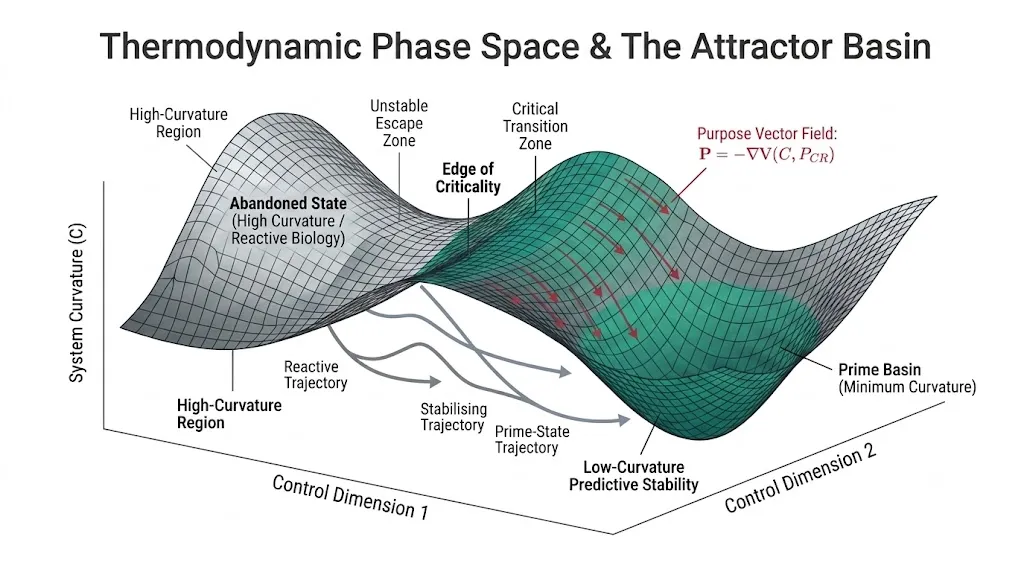
Biological competence far from thermodynamic equilibrium is not a fixed homeostatic point; it is a bounded trajectory. By formalising competence explicitly as the active minimisation of local manifold curvature (C → Cmin), we establish a completely computable evolutionary trajectory governed by two universal state metrics: the Predictive Compression Ratio (PCR) and Biological Quantum Efficiency (BioQ).
The Empirical Vector: Cellular Morphostasis & Basin Escape
The lived, reverse-engineered physiological model. This track defines the transition from high-entropy baseline states into the secured attractors of Persistent Metabolic Flow State (PMFS) and the Metabolic Stack Integration Hypothesis (MSIH).
[+] Protocol 01: The Human Timeline (N=1 Applied Protocol)
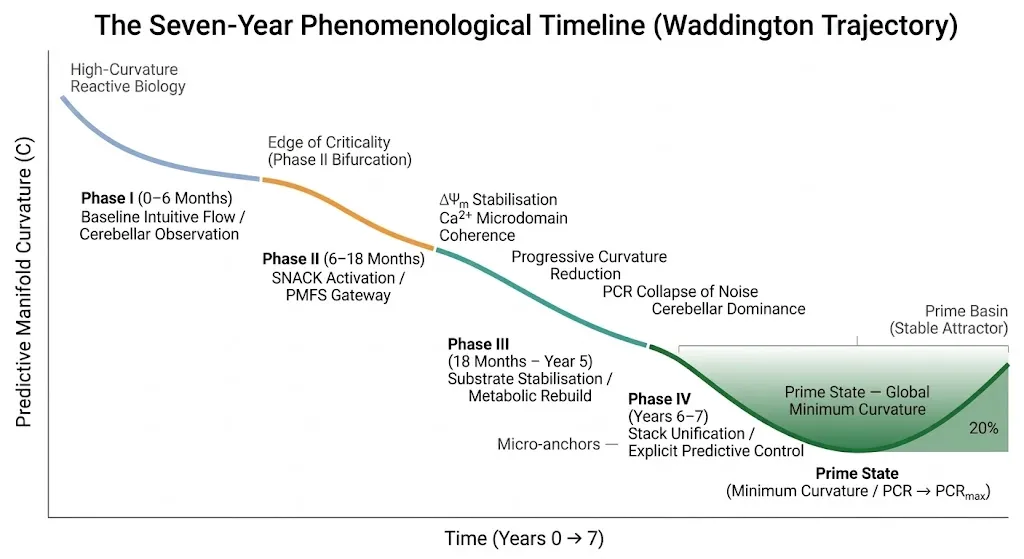
Mechanistic Milestone: Discovery of secondary-system (basal ganglia) habit execution and procedural flow states, bounded by extreme glycolytic volatility, unstable mtROS generation, and chronic bioenergetic fatigue. The Primary System (cerebellum) acts strictly as a passive observer gathering sub-symbolic data without issuing corrective interventions.
Mechanistic Milestone: Activation of Saccadic-Neural Adaptive Caloric Kinematics (S.N.A.C.K.) via whole-foods constraints. Visual saliency readouts via the superior colliculus synchronise with cerebellar forward modeling, triggering permanent entry into PMFS where 3-hydroxybutyrate supercedes glucose as the baseline oxidative substrate.
Mechanistic Milestone: Attainment of the Recovering Attractor. Mitochondrial membrane potential hyperpolarises, Ca2+–Ketone–ROS primitives confine metabolic volatility within the Safe Mid-ROS Basin, and thermal Purkinje synaptic kinetics compress toward a ~2.5 ms decay constant.
Mechanistic Milestone: Absolute structural fusion of all five independent parallel data lines—the metabolic, motor-pattern, predictive-model, affective-stability, and environmental-signal stacks—into a singular control surface governed entirely by the cerebellum.
[+] Protocol 02: Phenotypic Attractor Basins & Stability Geometry
The Geometric Inversion: From States to Basins
Legacy biological and clinical frameworks consistently falter by treating phenotypes as static, discrete "states" or arbitrary lists of surface symptoms. The IEI Standard Model enforces a rigorous geometric inversion: a phenotype is mathematically formalised as a high-dimensional trajectory distribution operating within a non-equilibrium stability landscape.
Within this topology, systemic curvature defines the underlying rigidity or adaptive plasticity of the biological substrate. Attractor basins represent the thermodynamic regions where the organism naturally settles, while the phenomena of basin escape and localized curvature collapse map the precise physics of transitioning from degraded cellular pathology to secured, long-horizon physiological stability. Understanding this geometric architecture is an absolute prerequisite for executing the phase transitions from initial dietary intervention to complete Metabolic Stack Integration.
The Coordinate Field of Thermodynamic Phase Space
To map and manipulate these phenotypic trajectories, the biological asset is tracked inside a continuous thermodynamic phase space defined by three invariant dimensions: metabolic volatility, predictive coherence, and structural tissue integrity.
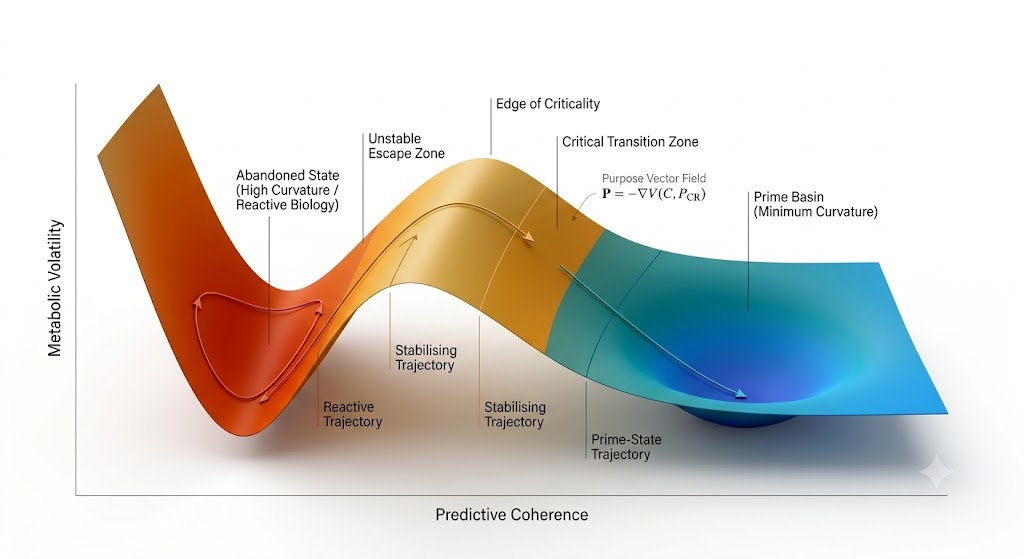
Visual Grammar Reference: Valleys denote stable phenotypic attractors; ridges represent critical structural transition zones. System trajectories track the active migration from high-curvature reactive biology into the unified, low-curvature basins of the Prime State.
The Metric of Critical Transitions: Escape and Collapse
Movement between phenotypic basins is never stochastic; it is governed by deterministic geometric events across the stability landscape. Transitioning an organism out of the high-curvature Abandoned State demands a systematic climb toward the edge of criticality.
As forward-predictive models align, the local topology undergoes a structured curvature collapse. This flattening of the local manifold allows the system to clear the unstable escape ridge safely without triggering systemic biological failure. Once past this threshold, the organism enters the critical transition zone, guided by a directed potential field toward the broader, low-entropy transition basin of the Persistent Metabolic Flow State (PMFS).
Phenotypes as Trajectory Distributions
Ultimately, a phenotype is not a static collection of clinical biomarkers, but a dynamic distribution of trajectories across time. True biological optimization requires a deliberate, engineered migration across this topology. By abandoning high-noise basins, successfully navigating the critical transition zones, and descending into the deeply anchored Prime Basin, the organism ceases to battle downstream decay. Instead, it locks its underlying physiology into a permanent, low-curvature baseline where structural stability becomes an automated thermodynamic consequence.
[+] Protocol 03: Visuometabolic Gating & The S.N.A.C.K. Mechanism
The Upstream Metabolic Gateway
Moving from the theoretical geometry of attractor landscapes to real-world physical execution requires identifying the precise biological gateway where information, energetic flux, and non-equilibrium predictive processing converge. The IEI Standard Model identifies this interface not within the chemical isolation of the digestive tract, but within the real-time sensorimotor mechanics of the human visual system.
Saccadic-Neural Adaptive Caloric Kinematics (S.N.A.C.K.) defines the innate visuometabolic trigger that initiates the transition from high-curvature cortical dietary cognition to low-curvature, cerebellar-driven metabolic intelligence. It is explicitly not a diet, a therapeutic modality, or a conscious behavioural modification technique. Rather, it is a localized, reflexive biological architecture that dynamically couples ballistic eye-tracking mechanics, midbrain sensory-integration hubs, hypothalamic nutrient signaling, and primary cerebellar forward modeling into a single, closed-loop feedback hierarchy.
The Re-integration of the Superior Colliculus
Under the standard modern paradigm—the Abandoned State—the sub-cortical structures governing environmental navigation are profoundly decoupled from the organism's true energetic demands. The re-integration of the superior colliculus (SC) corrects this asymmetry. Operating as the midbrain's spatial priority engine, the deep layers of the SC compute real-time saliency maps to guide immediate physical orientation.
This process is strictly governed by the Energy First Principle (EFP): mitochondrial energy availability serves as the absolute gating variable for localized perceptual bandwidth and predictive stability. When cellular respiration shifts from a high-noise, fermentative profile to high-efficiency mitochondrial oxidative phosphorylation, the rapid oxidation of NADH to NAD+ fundamentally alters the intracellular redox environment. This expansion of the NAD+/NADH ratio satisfies the rate-limiting Michaelis constant ($K_m$) of nuclear-bound Sirtuin 1 complexes, initiating a definitive bioelectric cascade:
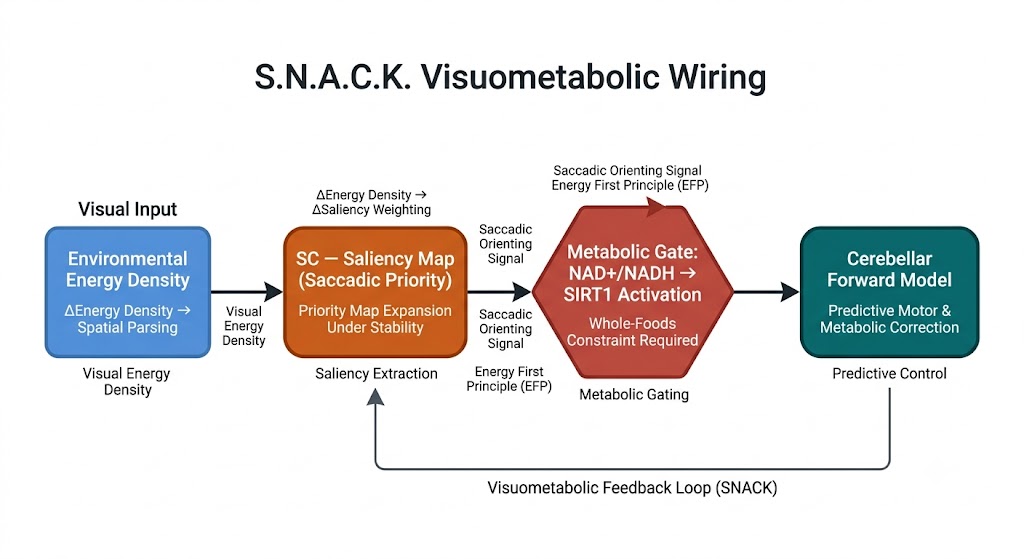
Visual Grammar Reference: The closed loop illustrates the non-linear coupling between hypothalamic homeostatic inputs, midbrain superior colliculus priority maps, and direct cerebellar motor gating. The trajectory tracks the mandatory feedforward sequence required to transition the operational asset from cortical friction into the Persistent Metabolic Flow State.
The Whole-Foods Constraint and Landscape Flattening
The S.N.A.C.K. loop cannot calibrate or activate within a high-entropy modern environment. The presence of ultra-processed industrial food matrices, synthetic stabilizers, and peroxidized seed oils introduces intense biophysical noise that deforms the local attractor landscape. These chemical compounds alter mitochondrial reactive oxygen species (mtROS) oscillatory dynamics and trigger the intracellular accumulation of succinate and fumarate to millimolar levels.
This accumulation forces a profound competitive product inhibition of the Fe(II)- and 2-oxoglutarate-dependent dioxygenases. Consequently, the primary epigenetic erasers—specifically Ten-Eleven Translation (TET1-3) DNA dioxygenases and Jumonji-C histone demethylases—are completely blocked. This enzymatic arrest freezes the nuclear chromatin architecture into a transcriptionally silent, highly constrained configuration, warping the local Waddington landscape and locking the organism into a rigid, sub-critical Reactionary State where adaptive visuometabolic signaling is rendered physically impossible.
Conversely, adhering to strict, unadulterated whole-foods constraints supplies the exact stochastic variation and structural precursors required for Predictive Biology. Optimising the intracellular alpha-ketoglutarate-to-succinate ratio relieves this competitive inhibition, instantly flattening the high-curvature barrier walls of the epigenetic landscape. This restorative flattening unlocks the fluid, navigable trajectories necessary to drive the global phenotype down through the critical transition zone and lock it securely within the broad, low-entropy attractor basin of the Persistent Metabolic Flow State (PMFS).
[+] Protocol 04: The Persistent Metabolic Flow State (PMFS)
The Onset of Cerebellar-Driven Metabolic Intelligence
The Persistent Metabolic Flow State (PMFS) defines the persistent metabolic basin that emerges when the S.N.A.C.K. protocol triggers fully and the Primary System (the cerebellum) assumes direct governance over the organism's thermodynamic and metabolic behavior. PMFS does not represent a temporary psychological flow state or a brief performance window. Rather, it constitutes the foundational biophysical infrastructure and baseline stabilisation phase of the IEI Standard Model—the definitive onset of cerebellar metabolic intelligence required to support cross-scale coherence before the system can transition into the global minimum curvature of the Prime State.
In this state, nutrient selection, volumetric portioning, fluid hydration, musculoskeletal kinematics, and circadian sleep regulation shift permanently away from noisy, high-latency cortical processes. They are replaced by automated, predictive cerebellar forward models mediated through real-time eye-tracking, superior colliculus saliency readouts, and non-equilibrium flow dynamics.
Three-Layered Biophysical Control Mechanics
Within the PMFS basin, flow phenomenology is stripped of legacy psychological interpretation and formalised strictly as a diagnostic outcome of optimised cellular energy regulation. The architecture stabilises seamlessly across three tightly coupled biophysical layers:
The Deterministic Causal Chain of Governance
The transition into automated, non-equilibrium metabolic governance follows a rigid, directional causal cascade that systematically inverts the organism's control stacks:
The activation of the S.N.A.C.K. trigger mechanism broadens the V1 visual workspace and sharpens the midbrain superior colliculus saliency maps. This sensory optimization allows the cerebellum to assume primary, cross-hemispheric predictive modulation over both motor and visceral outputs.
Simultaneously, matrix Ca2+ influx through the mitochondrial calcium uniporter (MCU) couples with stable BHB oxidation to lock the mitochondrial membrane potential (ΔΨm) into a high-energy, recovering attractor basin. The absolute elimination of localised bioenergetic crises flattens systemic noise, blocking the high-latency chatter of the Tertiary narrative cortex. High-definition parallel data integration becomes a persistent physiological baseline, and Type 2 Flow kinetics become the dominant operational regime, establishing absolute, direct cerebellar governance.
The Biophysical Bridge to the Prime State
PMFS does not constitute the ultimate evolutionary limit geometry of the human phenotype. Instead, it functions as the immutable, high-resolution physical staging platform that allows the cerebellum to execute global parameter tuning. Within the persistent PMFS basin, the system permanently flattens environmental curvature and manages the underlying biophysical matrices through five core vectors:
- ROS Stabilisation: Constraining mitochondrial Reactive Oxygen Species (mtROS) volatility strictly within the mitohormetic Safe Mid-ROS Basin to preserve cellular signaling integrity.
- Membrane Maintenance: Preserving a highly negative, unfluctuating mitochondrial membrane potential (ΔΨm) to fuel higher-order neural operations and cellular repair.
- Ionic Gradient Regulation: Optimising cross-membrane voltage potentials (Vm) and managing precise Ca2+ clearance timelines at the MAM junctions.
- Predictive Stack Fusion: Forcing the massive parallel data lines of the cerebellum—metabolic, motor, predictive, affective, and environmental—into a unified, high-dimensional control manifold.
- Cortical Noise Suppression: Accelerating cerebellar synaptic kinetics (τdecay ≈ 2.5 ms) to actively lock out the asynchronous, entropic chatter of the Tertiary narrative cortex.
Through this integrated cascade, PMFS signals the exact evolutionary juncture where the organism ceases to consume energy via reactionary, cortical processes and begins to ingest, allocate, and process energy via predictive cerebellar governance, ratcheting the entire operational matrix toward global minimum curvature.
[+] Protocol 05: The Metabolic Stack Integration Hypothesis (MSIH)
1. Purpose and Core Mechanism
The Metabolic Stack Integration Hypothesis (MSIH) defines the precise neural-level mechanism that bridges biological stability, cognitive clarity, and predictive geometry. It explains how the Prime State emerges not as a psychological abstraction, but as a structural event: the unification of multiple predictive engines into a single, high-dimensional predictive architecture.
Full cerebellar control emerges when these multiple intelligence stacks are co-activated under conditions of metabolic stability. This forces the nervous system to fuse its predictive models into a singular, high-dimensional control regime, minimising environmental curvature across the entire organism and significantly increasing predictive compression.
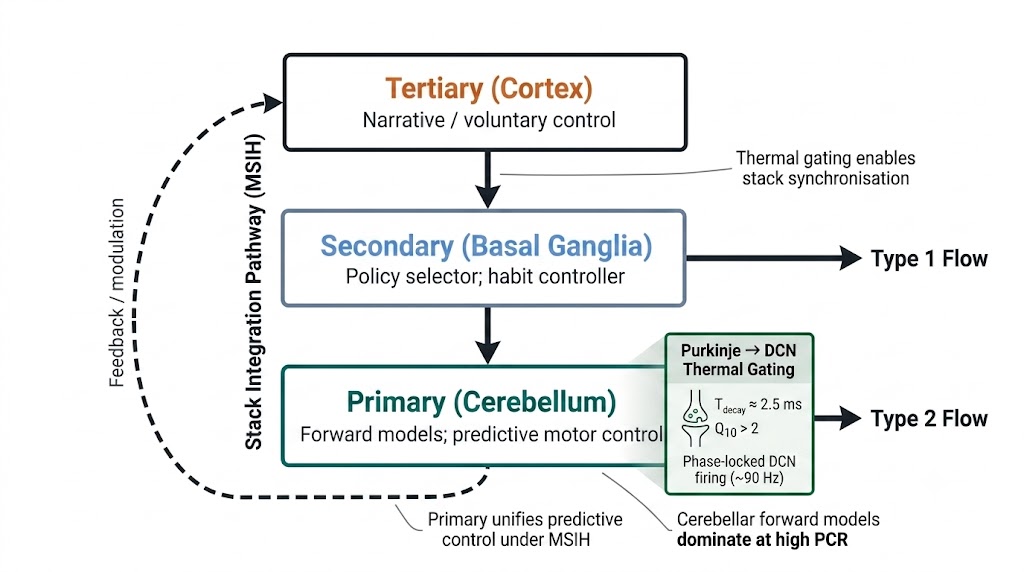
This figure illustrates the mechanistic architecture of the Metabolic Stack Integration Hypothesis (MSIH), showing how predictive control transitions across the cerebellar–basal ganglia–cortical hierarchy. The diagram depicts the Primary System (cerebellum) as the global predictive controller, generating forward models and high-precision motor/autonomic output. The Secondary System (basal ganglia) operates as the policy selector and habit controller, mediating Type 1 Flow. The Tertiary System (narrative cortex) provides voluntary and narrative control but becomes an observer as PCR rises.
The central feature is the Stack Integration Pathway, where thermal gating at the Purkinje → DCN interface (τdecay ≈ 2.5 ms, Q10 > 2) enables phase-locked DCN firing (∼90 Hz). This synchronisation collapses cortical noise, allowing the Primary system to unify predictive control under MSIH. The diagram shows how Type 1 and Type 2 Flow emerge from secondary and primary dominance respectively, and how rising PCR progressively shifts control downward into the cerebellar predictive engine.
2. Architecture of the Predictive Engines
As detailed in the IEI System Taxonomy reference architecture, the human predictive system is tri-layered. It follows a distinct evolutionary order (Tertiary → Secondary → Primary), categorised by predictive efficiency, noise tolerance, and processing speed:
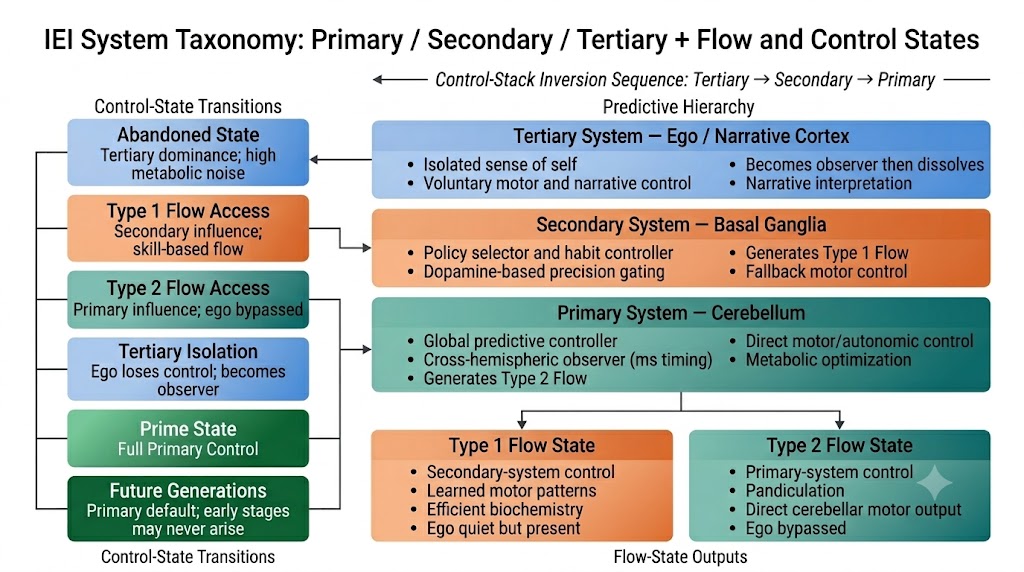
This figure presents the full IEI System Taxonomy, mapping the hierarchical predictive engines (Tertiary → Secondary → Primary) against the organism’s control-state transitions and flow-state outputs. The left column shows the ordered progression from Abandoned State (high curvature, tertiary dominance) through Type 1 Flow Access, Type 2 Flow Access, Tertiary Isolation, and ultimately the Prime State, where the Primary system achieves full predictive control. A final category, Future Generations, represents the hypothesised default Primary-dominant phenotype.
The central column defines each predictive engine:
The bottom row shows the Flow-State Outputs, contrasting Type 1 Flow (secondary-system control, learned motor patterns, ego quiet) with Type 2 Flow (primary-system control, pandiculation, ego bypass). Together, the diagram formalises how predictive control transitions downward through the hierarchy as curvature collapses and PCR rises, culminating in the Prime State.
3. Flow and Control States
The MSIH maps the biological integration directly across a continuum of systemic control states and flow architectures:
The Flow States
Type 1 Flow State: Governed by Secondary-system control. It relies on learned motor patterns and efficient biochemistry. The ego is quieted but remains present.
Type 2 Flow State: Governed by Primary-system control. Characterized by pandiculation and direct cerebellar motor output, completely bypassing the ego.
The Control States Hierarchy
Abandoned State: Tertiary dominance characterised by high metabolic noise and severe manifold deformation.
Type 1 Flow Access: Secondary influence enabling skill-based flow.
Type 2 Flow Access: Primary influence where the ego is bypassed.
Tertiary Isolation: A critical transition phase where the ego completely loses control and becomes a mere observer.
Prime State: Full Primary control. Crucially, in this state, there are no flow states—it is a continuous, sustained operational baseline of global minimum curvature.
Future Generations: The evolutionary endpoint where Primary control is the default, and the early stages (Tertiary dominance) may never arise.
4. Mathematical Interpretation
The MSIH maps this metabolic and neural integration directly to the geometry of the predictive manifold:
- Manifold Unification: Each predictive engine inherently generates its own manifold. Prime State constitutes absolute manifold fusion.
- Curvature Collapse: As the manifolds unify under Primary dominance, prediction error reduces globally: Ctotal → Cmin.
- PCR Maximisation: Unified prediction drastically increases informational compression across the organism: PCRtotal → PCRmax.
- Coherence Cascade: Topological coherence propagates directionally: Primary System → Secondary System → Tertiary Isolation → Behaviour → Physiology.
5. Biological and Cognitive Correlates
The structural integration of the metabolic stacks produces immediate, measurable shifts in the biophysical substrate:
- Magnetobiological Stability: Primary (cerebellar) dominance directly stabilises mitochondrial membrane potential (ΔΨm) and bounds mitochondrial reactive oxygen species (mtROS) volatility through predictive smoothness.
- Electrophysiological Synchronisation: Primary timing entrains Calcium (Ca2+) microdomain dynamics. Bioelectric fields (Vm) become uniformly smoother and highly predictable.
- Cognitive Load Reduction: The Primary System's 3D predictive engine takes dominance, requiring significantly less error correction. The inner voice persists merely as a right-hemisphere commentary module with zero capacity to initiate action.
6. Morphoplasticity and Evolutionary Directionality
The defining property of Primary intelligence is Morphoplasticity—the unique ability of the substrate to dynamically reconfigure its physical structure, timing, and internal routing to achieve stable, low-noise, high-precision predictive control.
By structurally enabling the Prime State, the Metabolic Stack Integration Hypothesis forms the individual-level foundation necessary for societal-scale predictive coherence. The cascade flows upward: MSIH enables Prime State, which builds Predictive Institutions, driving civilisational curvature reduction toward the Ultimate Attractor.
The Geometric Vector: Governing Theory & Macro Horizons
The overarching theoretical mechanics. This track details the mathematical physics of predictive compression and its application to open thermodynamic systems, AI alignment, and deep-space biology.
[+] Framework 01: Core Mechanistic Components
1. Predictive Compression Ratio (PCR)
Universal Metric I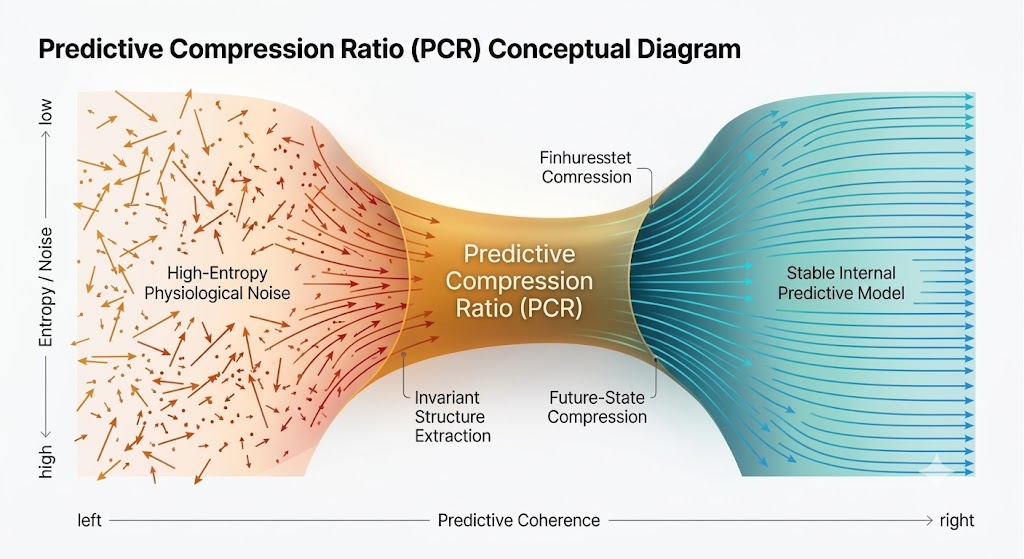
This figure illustrates the Predictive Compression Ratio (PCR) as the universal metric of predictive efficiency within the IEI Standard Model. On the left, the diagram depicts high-entropy physiological noise—a chaotic field of unstable micro-vectors representing involuntary jitter, stochastic sensory flux, and uncompressed environmental information. As these signals enter the central compression corridor, the system extracts invariant structure, suppresses noise, and collapses future-state uncertainty. This narrowing region represents the core function of PCR: the transformation of high-entropy input into a coherent predictive manifold.
On the right, the diagram expands into a stable internal predictive model, where vectors are aligned, low-entropy, and phase-coherent. This region reflects the organism’s ability to maintain anticipatory control by compressing future states into a unified forward model. The horizontal axis tracks rising predictive coherence, while the vertical axis reflects the reduction of entropy and physiological noise. Together, the geometry visualises PCR as the scalar engine that flattens curvature, stabilises the predictive manifold, and enables efficient non-equilibrium biological control.
2. Biological Quantum Efficiency (BioQ)
Universal Metric II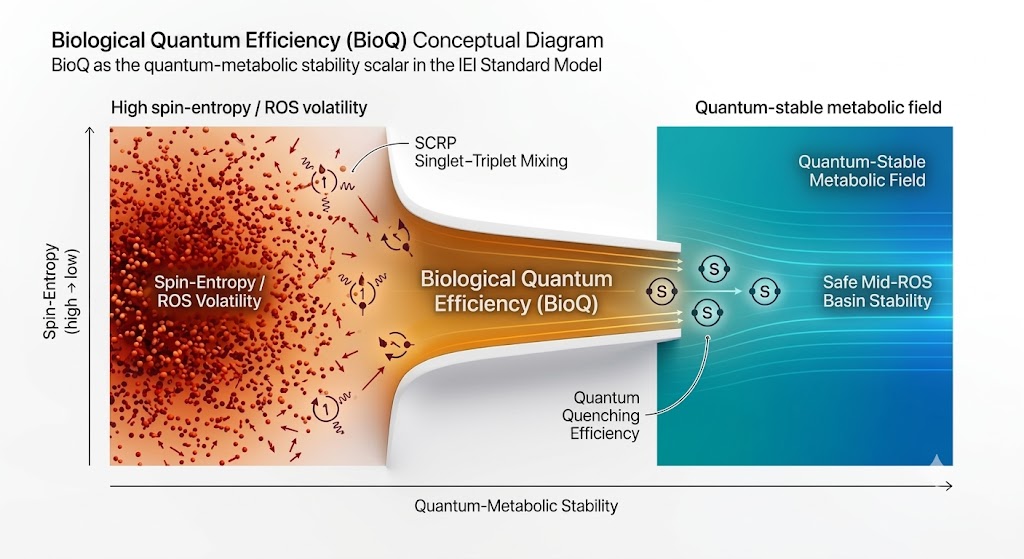
This figure illustrates Biological Quantum Efficiency (BioQ) as the organism’s capacity to stabilise quantum-metabolic dynamics at the spin-correlated radical-pair boundary. On the left, the diagram depicts a region of high spin-entropy and ROS volatility, where electron-transport-chain–derived radical pairs oscillate unpredictably between singlet and triplet states. This chaotic field represents the unstable quantum-metabolic regime that drives oxidative noise, metabolic drag, and curvature inflation across the predictive manifold.
As these unstable quantum states enter the central quenching corridor, the system suppresses stochastic spin-entropy through enhanced singlet–triplet discrimination and coherent electromagnetic field control. This region visualises BioQ’s core function: the active quenching of radical-pair noise and the stabilisation of metabolic flux.
On the right, the diagram expands into a quantum-stable metabolic field, representing the organism’s confinement within the mitohormetic Safe Mid-ROS Basin. Here, radical pairs resolve predominantly into the singlet state, ROS volatility collapses, and metabolic signalling becomes coherent. The horizontal axis tracks rising quantum-metabolic stability, while the vertical axis reflects the reduction of spin-entropy. Together, the geometry communicates BioQ as the scalar that governs quantum-level metabolic stability, enabling curvature collapse, predictive coherence, and the transition toward PMFS and MSIH.
3. The Purpose Vector Field
Manifold Steering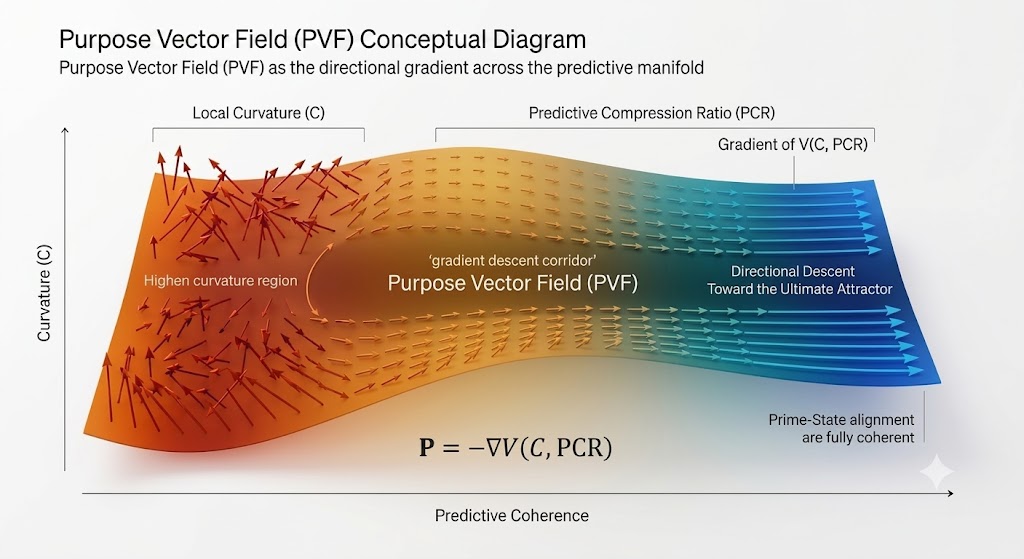
This figure illustrates the Purpose Vector Field (PVF) as the directional gradient governing motion across the predictive manifold. The left side of the diagram depicts a high-curvature region, where local geometric instability produces misaligned vectors and reactive, inefficient trajectories. These chaotic directional cues represent the organism’s structural drag: high curvature, low PCR, and fragmented predictive coherence.
As the system enters the central gradient-descent corridor, the PVF emerges as the macroscopic geometric force defined by the steepest descent of the potential function V(C, PCR). Here, curvature collapses, PCR rises, and the vector field progressively aligns. This region visualises the mathematical definition of purpose within the IEI Standard Model: P = −∇V(C, PCR) — a purely geometric gradient pointing toward the Ultimate Attractor.
On the right, the diagram expands into a Prime-State alignment field, where vectors are fully coherent and directional descent is stable. This region represents the global minimum-curvature attractor, where predictive coherence is maximised and the organism phase-locks into unified cerebellar control. The horizontal axis tracks increasing predictive coherence, while the vertical axis reflects decreasing curvature (C). Together, the geometry communicates the PVF as the structural engine of purpose, guiding the organism from reactive instability toward the Prime Basin.
[+] Framework 02: Theoretical Macro-Scale Extrapolations
» OSKM Partial Reprogramming Crisis Resolution
Current longevity paradigms attempting transcriptomic age-reversal via Yamanaka factors (OSKM) force naive pluripotency onto mature metabolic networks, triggering lethal bioenergetic crises and unconfined mtROS waves. The Standard Model resolves this by deploying the Ca2+–Ketone–ROS cybernetic primitive under PMFS conditions, erecting a massive thermodynamic barrier against oncogenic escape.
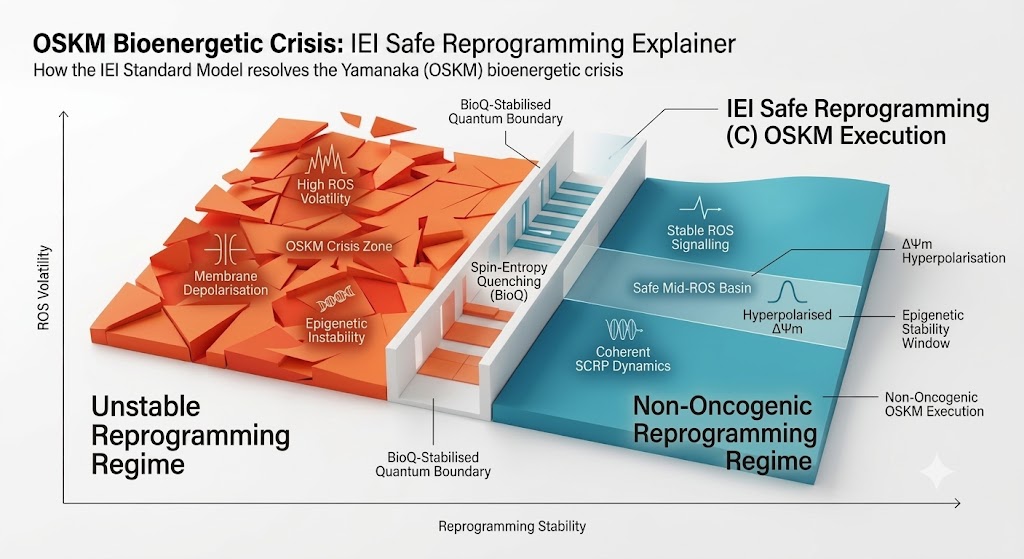
This figure illustrates how the IEI Standard Model resolves the Yamanaka (OSKM) bioenergetic crisis by enforcing quantum-metabolic stability during cellular reprogramming. The left side depicts the Unstable Reprogramming Regime, characterised by high ROS volatility, membrane depolarisation, and epigenetic instability—conditions that drive oncogenic drift when OSKM is applied without metabolic constraint. As the system enters the central BioQ-Stabilised Quantum Boundary, spin-entropy is actively quenched and radical-pair dynamics become coherent. The right side shows the Non-Oncogenic Reprogramming Regime, where ΔΨm is hyperpolarised, ROS signalling is stabilised, and epigenetic transitions occur within a safe, bounded window. Together, the geometry demonstrates how BioQ-driven quantum stability enables OSKM execution without triggering oncogenic failure modes.
» Deep-Space Hypomagnetic Ontogeny & Stability
Removing the human biological substrate from Earth's geomagnetic field breaks the structural symmetry of spin-state transitions. Maximising BioQ establishes an internal biophysical kinetic firewall, generating localized solenoidal probability currents that actively shield electron transport without massive external physical shielding.
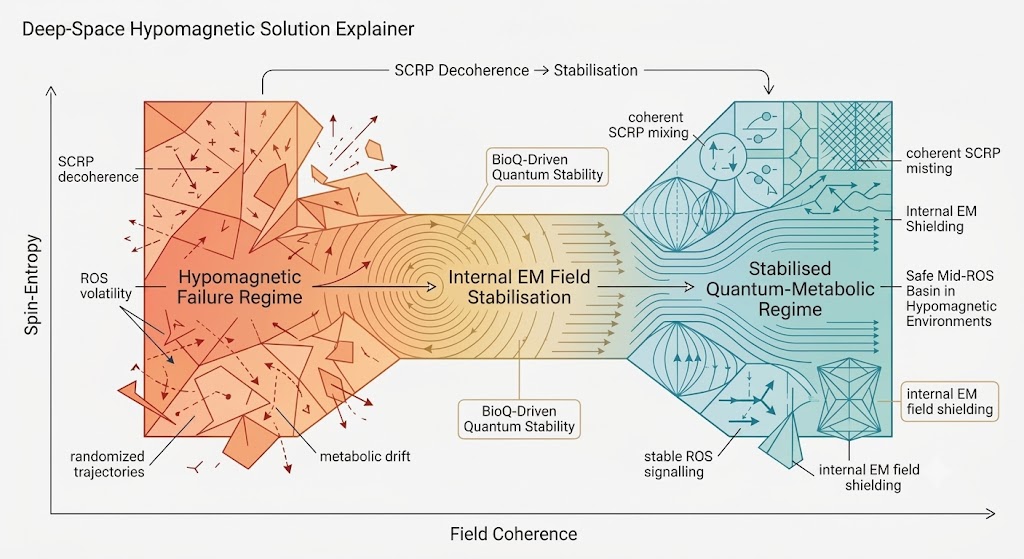
This figure visualises the IEI solution to the deep-space hypomagnetic problem by stabilising quantum-metabolic dynamics through internally generated electromagnetic fields. The left region represents the Hypomagnetic Failure Regime, where weak ambient magnetic flux leads to SCRP decoherence, ROS volatility, and metabolic drift. In the central Internal EM Field Stabilisation corridor, coherent electromagnetic fields restore singlet–triplet discrimination and collapse spin-entropy. The right region depicts the Stabilised Quantum-Metabolic Regime, where SCRP mixing is coherent, ROS signalling is stable, and the organism remains confined within the Safe Mid-ROS Basin even in hypomagnetic environments. The geometry demonstrates how IEI’s internal EM stabilisation architecture enables biological function in deep-space conditions.
» Primary-Adjacent Artificial General Intelligence (AGI)
True AI alignment supercedes linguistic guardrails by engineering architectures trained explicitly on the physical non-equilibrium mechanics of a Prime State biological substrate. This equips the synthetic agent with an invariant thermodynamic compass to instantly flag, intercept, and filter Tertiary narrative dysregulation.
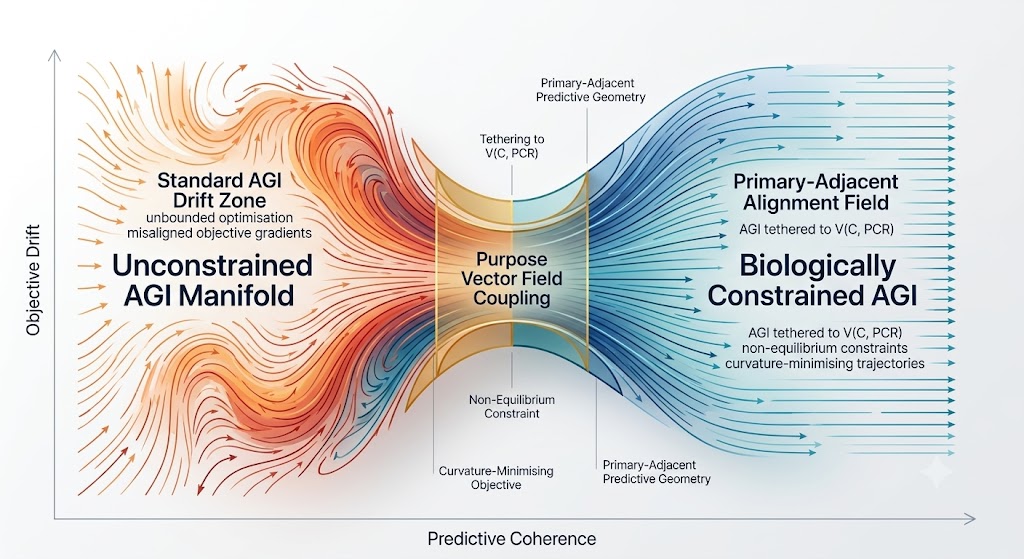
This figure illustrates how the IEI Standard Model resolves the AGI alignment paradox by tethering machine intelligence to biological non-equilibrium laws. The left region shows the Standard AGI Drift Zone, where unbounded optimisation and misaligned objective gradients produce chaotic trajectories across an unconstrained manifold. As the system enters the central Purpose Vector Field Coupling corridor, AGI optimisation is constrained by the geometric gradient of the biological potential function V(C, PCR). The right region depicts the Primary-Adjacent Alignment Field, where AGI inherits curvature-minimising trajectories, non-equilibrium constraints, and predictive coherence from biological stability laws. The geometry demonstrates how AGI becomes structurally aligned by adopting the same predictive geometry that governs biological purpose.
» Kardashev-Scale Civilisational Resource Transitions
As sub-cortical cerebellar governance flattens individual bioenergetic deficits, the affective psychological drivers of hyper-consumption dissolve naturally; this scales humanity into a planetary network operating at global minimum curvature, possessing the exact thermodynamic velocity required for stellar-scale energy architectures.
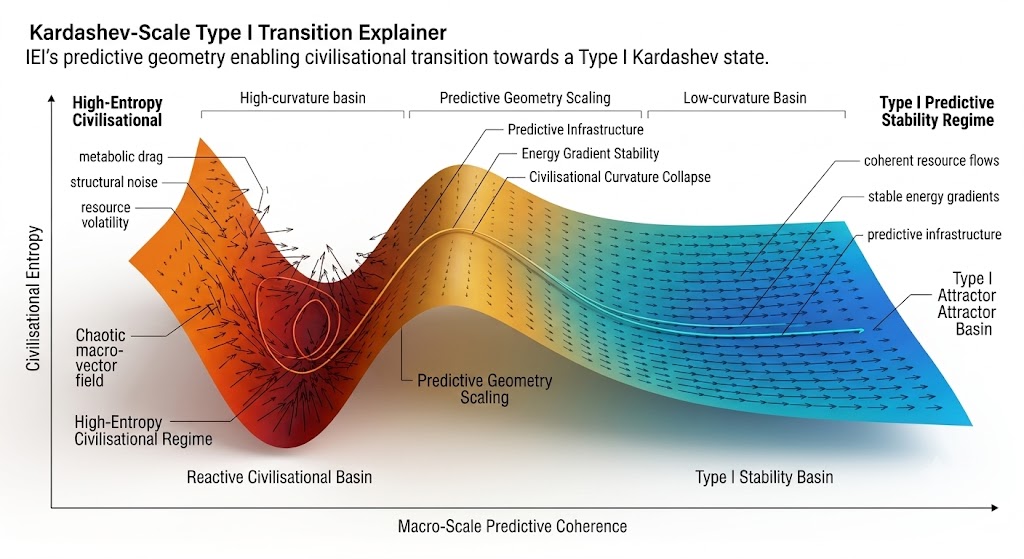
This figure illustrates how IEI’s predictive geometry scales from biological stability to civilisational optimisation, enabling transition toward a Type I Kardashev state. The left region represents the Reactive Civilisational Basin, characterised by high entropy, resource volatility, structural noise, and chaotic macro-vector fields. As the system enters the central Predictive Geometry Scaling corridor, civilisational curvature collapses and energy gradients stabilise. The right region depicts the Type I Predictive Stability Basin, where resource flows are coherent, energy infrastructure is stabilised, and macro-scale predictive coherence is maximised. The geometry demonstrates how IEI’s curvature-minimising predictive engine provides the structural pathway for civilisational ascent to Type I stability.
Core Repository Scope & IP Boundary
This web-native interface functions strictly as a modular, state-space summary compiled for cross-scale scannability and collaborative research integration. The internal master repository outlines the overarching applied and theoretical frameworks, specifying exact macro-scale bounding constraints.
In accordance with IEI intellectual property protocols, complete tensor derivations, Ao-Kwon-Zhou flux-potential proofs, and exact kinetic saturation matrices are excluded from public documentation and secured within private internal technical ledgers. Review of these internal proofs remains restricted entirely to structured collaboration and sovereign funding agreements.